Graphic Art for Lds Sunday School Bulletins on New Years Resolution
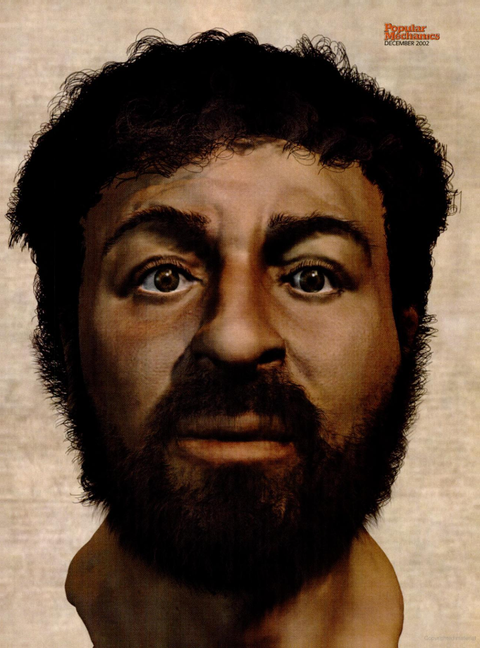
Originally published in December 2002, the Popular Mechanics article "The Real Face of Jesus" created a face up for the most famous historical effigy in human being history. Since then, science has continued reconstructing faces from throughout history, from Stone Age humans to European royalty.
2 decades later, we are reproducing one of the nigh widespread stories in the history of Popular Mechanics, along with how information technology get-go appeared in the Dec 2002 upshot. Why does Mike Fillon's "The Real Face of Jesus" proceed to endure, well-nigh two decades after publication? Read on and find out.
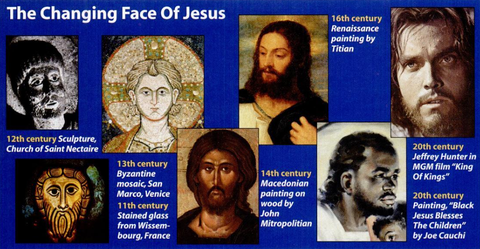
From the offset time Christian children settle into Sunday school classrooms, an image of Jesus Christ is etched into their minds. In North America he is most often depicted as being taller than his disciples, lean, with long, flowing, light brown hair, off-white skin and light-colored optics. Familiar though this image may be, it is inherently flawed. A person with these features and physical bearing would take looked very unlike from everyone else in the region where Jesus lived and ministered. Surely the authors of the Bible would have mentioned so stark a dissimilarity.
On the contrary, according to the Gospel of Matthew, when Jesus was arrested in the garden of Gethsemane earlier the Crucifixion, Judas Iscariot had to indicate to the soldiers whom Jesus was considering they could not tell him apart from his disciples. Farther clouding the question of what Jesus looked similar is the elementary fact that nowhere in the New Attestation is Jesus described, nor have any drawings of him ever been uncovered.
There is the additional problem of having neither a skeleton nor other bodily remains to probe for DNA. In the absence of evidence, our images of Jesus have been left to the imagination of artists.
The influences of the artists' cultures and traditions tin can be profound, observes Carlos F. Cardoza-Orlandi, associate professor of world Christianity at Columbia Theological Seminary in Atlanta. "While Western imagery is dominant, in other parts of the world he is ofttimes shown as black, Arab or Hispanic." And so the fundamental question remains: What did Jesus look like?
An respond has emerged from an heady new field of science: forensic anthropology. Using methods like to those police have adult to solve crimes, British scientists, assisted by Israeli archeologists, have re-created what they believe is the almost accurate image of the most famous face up in man history.
The Trunk As Prove
An outgrowth of concrete anthropology, forensic anthropology uses cultural and archeological data likewise as the concrete and biological sciences to study unlike groups of people, explains A. Midori Albert, a professor who teaches forensic anthropology at the Academy of North Carolina at Wilmington.
Experts in this highly specialized field require a working knowledge of genetics, and human growth and development. In their research they too describe from the fields of primatology, paleoanthropology (the study of primate and human development) and human osteology (the study of the skeleton). Fifty-fifty seemingly distant fields like diet, dentistry and climate adaptation play a function in this type of investigation.
While forensic anthropology is unremarkably used to solve crimes, Richard Neave, a medical artist retired from The University of Manchester in England, realized information technology also could shed light on the advent of Jesus. The co-author of Making Faces: Using Forensic And Archaeological Evidence, Neave had ventured in controversial areas before. Over the by two decades, he had reconstructed dozens of famous faces, including Philip Ii of Macedonia, the father of Alexander the Groovy, and Rex Midas of Phrygia. If anyone could create an accurate portrait of Jesus, information technology would be Neave.
Reconstructing Jesus
Matthew's clarification of the events in Gethsemane offers an obvious clue to the confront of Jesus. It is articulate that his features were typical of Galilean Semites of his era. And so the first stride for Neave and his research team was to acquire skulls from near Jerusalem, the region where Jesus lived and preached. Semite skulls of this type had previously been found by Israeli archeology experts, who shared them with Neave.
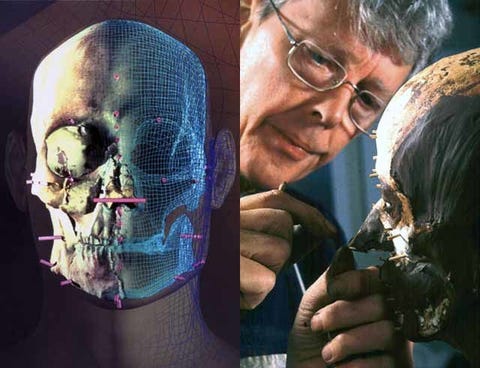
With three well-preserved specimens from the fourth dimension of Jesus in hand, Neave used computerized tomography to create X-ray "slices" of the skulls, thus revealing minute details about each one's structure. Special computer programs then evaluated reams of information about known measurements of the thickness of soft tissue at cardinal areas on human faces. This made it possible to re-create the muscles and skin overlying a representative Semite skull.
The entire process was accomplished using software that verified the results with anthropological data. From this data, the researchers built a digital 3D reconstruction of the face up. Next, they created a bandage of the skull. Layers of dirt matching the thickness of facial tissues specified by the computer program were and so applied, along with simulated peel. The nose, lips and eyelids were then modeled to follow the shape adamant by the underlying muscles.
A Matter Of Manner
Two central factors could not be determined from the skull—Jesus'due south hair and coloration. To fill in these parts of the picture, Neave'southward squad turned to drawings found at various archeological sites, dated to the first century. Drawn before the Bible was compiled, they held crucial clues that enabled the researchers to make up one's mind that Jesus had nighttime rather than light-colored optics. They also pointed out that in keeping with Jewish tradition, he was disguised as well.
Information technology was the Bible, nonetheless, that resolved the question of the length of Jesus's hair. While most religious artists accept put long hair on Christ, most biblical scholars believe that information technology was probably short with tight curls. This assumption, still, contradicted what many believe to be the most authentic depiction: the confront seen in the image on the famous—some say infamous—Shroud of Turin.
The shroud is believed past many to exist the fabric in which Jesus'southward torso was wrapped after his death. Although there is a difference of opinion as to whether the shroud is genuine, information technology clearly depicts a figure with long hair. Those who criticize the shroud's legitimacy point to i Corinthians, i of the many New Testament books the campaigner Paul is credited with writing. In one chapter he mentions having seen Jesus—then later describes long pilus on a human as disgraceful.
Would Paul have written "If a man has long hair, it is a disgrace to him" if Jesus Christ had had long pilus? For Neave and his team this settled the issue. Jesus, as drawings from the offset century describe, would accept had brusk pilus, advisable to men of the fourth dimension.
The historic record too resolved the consequence of Jesus'south superlative. From an analysis of skeletal remains, archeologists had firmly established that the average build of a Semite male at the fourth dimension of Jesus was 5 ft. 1 in., with an average weight of well-nigh 110 pounds. Since Jesus worked outdoors as a carpenter until he was near 30 years erstwhile, it is reasonable to presume he was more muscular and physically fit than westernized portraits advise. His face was probably atmospheric condition-beaten, which would have made him announced older, too.
An Accurate Portrait
For those accustomed to traditional Sunday school portraits of Jesus, the sculpture of the dark and swarthy Eye Eastern man that emerges from Neave'south laboratory is a reminder of the roots of their organized religion.
"The fact that he probably looked a keen deal more like a darker-skinned Semite than westerners are used to seeing him pictured is a reminder of his universality," says Charles D. Hackett, director of Episcopal studies at the Candler Schoolhouse of Theology in Atlanta. "And [it is] a reminder of our tendency to sinfully advisable him in the service of our cultural values."
Neave emphasizes that his re-cosmos is merely that of an developed human who lived in the aforementioned identify and at the aforementioned fourth dimension as Jesus. As might well exist expected, non everyone agrees.
Forensic depictions are not an exact science, cautions Alison Galloway, professor of anthropology at the University of California in Santa Cruz. The details in a face follow the soft tissue higher up the muscle, and it is here where forensic artists differ widely in technique. Galloway points out that some artists pay more than attention to the subtle differences in such details equally the distance between the bottom of the nose and the oral cavity. And the nigh recognizable features of the face—the folds of the eyes, structure of the nose and shape of the mouth—are left to the artist.
"In some cases the resemblance between the reconstruction and the actual individual tin be uncanny," says Galloway. "Only in others in that location may be more resemblance with the other work of the same artist."
Despite this reservation, she reaches one determination that is inescapable to nigh everyone who has ever seen Neave's Jesus. "This is probably a lot closer to the truth than the piece of work of many bang-up masters."
This content is created and maintained past a third party, and imported onto this page to aid users provide their email addresses. You may be able to find more information well-nigh this and similar content at pianoforte.io
Source: https://www.popularmechanics.com/science/health/a234/1282186/
0 Response to "Graphic Art for Lds Sunday School Bulletins on New Years Resolution"
Post a Comment