what to use to cover ceiling with fiberglass insulation
Expert advice on how to install fiberglass insulation, including methods for insulating walls, floors, ceilings, attics, and more. Includes cutting and fastening insulation, and insulating effectually obstacles.
Fiberglass insulation is energy efficient, affordable, easy to install, and readily available in a wide variety of sizes, types, and R-values. It tin keep your dwelling house warm in wintertime and comfortably cool in summertime.
And, fiberglass insulation can reduce your energy consumption, resulting in lower utility bills and contributing to a healthier planet.
Notwithstanding, it's critically important that you install the insulation correctly and are compliant with all applicable building codes.
Here, we'll look at several proven methods of installing fiberglass insulation, all of which are well within the capabilities of DIY homeowners.
Fiberglass Insulation Types
Following is a brief description of fiberglass insulation. For more, please encounter Dwelling house Insulation Buying Guide.
Fiberglass insulation, composed of finely spun glass fibers, is today's most popular type of residential insulation. It is available in three forms: rolls, batts, and loose fill.
- Ringlet insulation comes in long, rolled-upwards strips. It tin be custom-cut to fit existing spaces.
- Batt insulation is similar to roll insulation, except that information technology comes precut in ready-to-install strips. Batts are oft easier and quicker to install because they profoundly reduce the amount of cut required.
- Loose-fill insulation, sometimes called blown-in insulation, consists of fluffy bits of fiberglass that are easily spread by hand or blown into place by a mechanical blower. Most home comeback stores hire insulation blowers.
Whorl and batt insulation are sold in 2 standard widths: 15 inches wide for plumbing equipment between wood framing placed xvi inches on centre, and 23 inches wide for framing that's 24 inches on eye.

Both types are available faced with kraft paper or aluminum foil, which serve equally a wet barrier. They're also available unfaced, meaning they take no wet barrier. Unfaced insulation is often laid over existing insulation to increase domicile free energy efficiency.
When you lot install faced insulation, the moisture bulwark (newspaper or foil) must confront toward the heated and cooled side of the room, so when insulating between wall studs, be sure the paper or foil moisture barrier faces toward the room.
Agreement R-Values
The R-value of insulation tells you its insulating value. Information technology is a measure of thermal resistance that prevents the transfer of rut. The higher the R-value number, the thicker the insulation is and the improve information technology insulates.
The exact R-value you demand depends on several factors, including the size and structure of your home and the geographic expanse in which you live.
As a general rule, homes with ii-by-4 framed walls crave R-13 insulation, and 2-past-6 framed walls require R-19 insulation. The standard R-value for insulating attics is between R-30 and R-twoscore.
For more than, run across What You lot Should Know About Insulation.
How to Insulate Walls
Walls are typically insulated with faced batt insulation because it comes precut into strips that fit standard 8-foot-tall walls. Still, faced curl insulation is also perfectly acceptable. Yous'll only have to cut the strips to length to fit betwixt each stud.
Caution: Installing fiberglass insulation exposes y'all to fine glass fibers, which are irritating to the skin, optics, and lungs. Whenever yous handle the insulation, wearable long pants, a long-sleeved shirt, tight-plumbing equipment eye goggles, gloves, and a dust mask, or better yet, a dual-cartridge respirator. To keep the itchy glass fibers from sticking to your neck, sprinkle babe powder onto the exposed skin around your shirt collar.
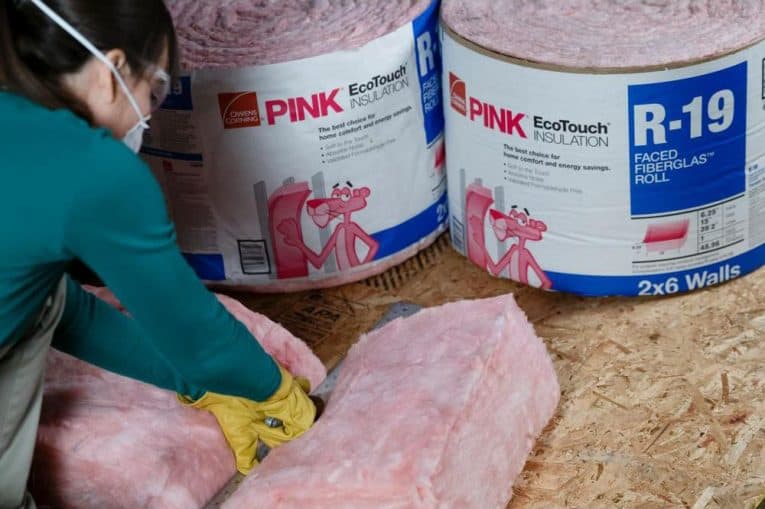
There are a few dissimilar ways to slice through insulation, only the simplest method for do-information technology-yourselfers is to use a straightedge and utility knife as shown in the photo below.
How to Cut Insulation
- Make a straightedge from a 1-by-6 or 1-by-8 lath, cutting information technology 12 to xviii inches longer than the width of the insulation.
- Lay the insulation onto a chip piece of plywood to protect the surface on which you're working. Be certain the faced side—the side with the kraft paper or foil moisture barrier—is facing downward.
- Measure the slice and add together an actress inch for a tight fit, and and so marking the insulation with a felt-tip mark.
- Fix the straightedge across the insulation, aligning it with the cut mark.
- Kneel on ane stop of the straightedge and printing downward on the opposite end with your hand. Guide the utility pocketknife along the straightedge to slice through the insulation. You may need to make two or iii passes to cut all the manner through.
-
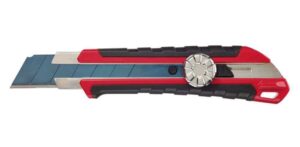
Utility Pocketknife with Snap-Off Bract
PRO TIP: To cut through thick batts, use a utility pocketknife that has a snap-off blade (shown here). Extend the blade out nigh three inches, so tighten the locking knob. The extra-long blade makes it much easier to slice through thick insulation. Just be conscientious with this super-abrupt, long blade!
How to Fasten Insulation
- Gently press the insulation between 2 studs with its wet barrier facing out toward the room. The energy efficiency of fiberglass insulation is based on its ability to trap air. Therefore, be careful not to compress the insulation too much—compression will reduce its insulating value.
- Unfold the mounting tab forth each vertical edge of the batt.
- Flatten the tabs against the front border of the stud on each side of the batt. Apply a staple gun and ¼-inch staples to spike the tabs to the edges of the studs, spacing the staples near 12 inches apart.
- Check to confirm that all staples are driven flat to the surface. If you find whatsoever protruding staples, tap them down with a Otherwise, they'll interfere with the drywall installation. Some building codes require stapling the tabs to the inside flat sides of the studs, not to the narrow front edge. Information technology's wise to check with the building department in your town for the code-approved stapling method.
Insulating Around Obstacles
When you lot come beyond a wire or pipe, don't just lay the insulation over information technology. That creates an energy-wasting void behind the obstruction and compresses the insulation.
Instead, split the insulation, starting from whichever end of the insulation is closest to the obstacle. And then, slip the rear one-half of the insulation behind the wire or pipe and lay the other half in front end of it, sandwiching the object.
There are 2 means to deal with outlets, wall switches, and other electrical boxes.
The get-go method is cutting the insulation to fit snugly around the box.
Nonetheless, virtually professional contractors use a amend technique: Start by filling the void backside the box with either expanding foam sealant or a thick block of rigid polystyrene foam.
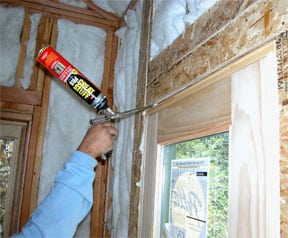
Notch the insulation to fit tightly around the box so that the insulation completely encases the box. Be careful non to get any insulation inside the electric box.
How to Insulate Nether Floors
Information technology'southward of import to insulate floors above basements, crawl spaces, and other unconditioned areas.
Yous can insulate between the floor joists using faced or unfaced fiberglass.
Rolls are preferred over batts because they come in longer lengths, which often allow y'all to run continuous strips across the entire length of the floor. Most floors are framed with 2-by-10s and require R-38 insulation.
- Cut the insulation to fit and gently press it up between the floor joists. If you're using faced insulation, be sure the wet barrier goes confronting the underside of the subfloor.
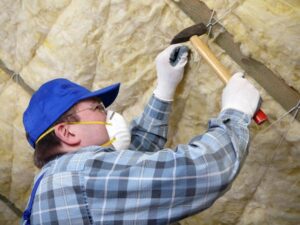
- Secure the insulation using stay wires. These are precut lengths of 14-estimate spring steel wire that are slightly longer than the infinite between the joists. Press the wires up confronting the insulation and the pointed ends of the wires will dig into the joists, holding the insulation in place. Space stay wires about two anxiety apart.
PRO TIP : As an alternative to stay wires, y'all can staple chicken wire or secure webbing to the underside of the floor joists to hold the insulation in place.
How to Insulate Attic Floors
A well-insulated cranium floor blocks the upwardly movement of heated air in winter and cooled air in summer. Every bit a event, your house feels more comfortable, and y'all'll reduce your energy consumption.
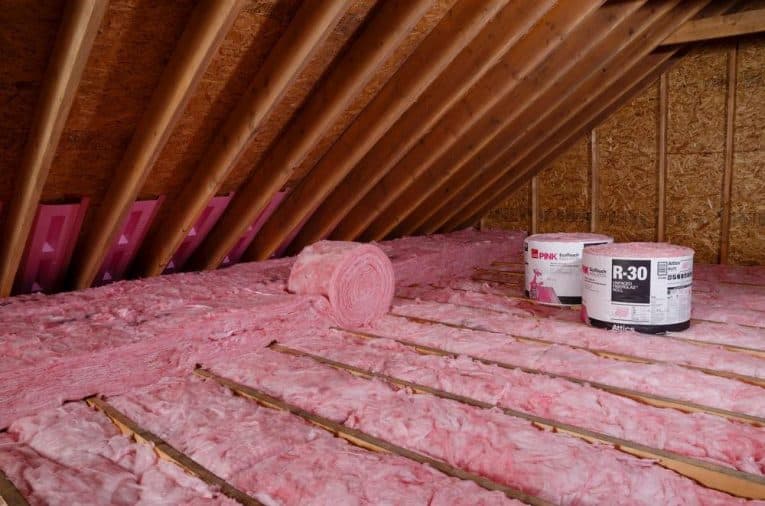
Insulating the attic consists of setting insulation between the floor joists, which are the ceiling joists of the room below.
Nevertheless, you must complete an important pace before installing any insulation: Use fireproof caulk to seal up cracks, holes, and openings around all penetrations, such equally pipes, ducts, and cables. This prevents air from leaking through the ceiling and into the cranium, and dramatically enhances the energy efficiency of the insulation.
If your attic floor has no insulation, install faced batts or faced rolls between each joist, with the moisture bulwark facing downwards against the drywall or plaster ceiling below.
If there is already insulation betwixt the joists, increase the R-value by installing unfaced scroll insulation right on peak. Run the unfaced strips perpendicular to the joists and butt each strip tightly together to form an airtight blanket of insulation. Or, top the existing insulation with a thick layer of loose-fill up fiberglass, which you tin spread past hand or with a mechanical blower.
Attic Insulation Details
Insulating attics is rather straightforward, but go along in mind these ii important factors:
Showtime, be careful when insulating around recessed lite fixtures. If it'south a standard fixture, which typically has a cylindrical metallic "tin" projecting upwardly into the attic, do not let whatever insulation to contact the fixture. When the light is on, the recessed fixture gets very hot, and it could ignite the insulation. Maintain a clearance infinite of at to the lowest degree three inches effectually all sides of the fixture.
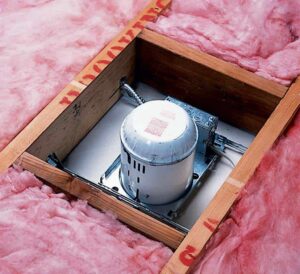
In that location is an exception to this dominion. If the recessed light is an IC-rated fixture, then you tin can lay the insulation right over the top. (IC stands for insulation contact.) An IC-rated fixture has a large, square, superinsulated metal housing that protrudes into the attic.
If yous're not sure if your recessed fixtures are standard or IC-rated, contact an electrician or house inspector.
Finally, be careful non to stuff the insulation also deeply into the area along the eaves of the house. Doing and then will cake the soffit vents and foreclose outside air from flowing into the cranium and out a ridge or gable-end vent. If necessary, staple polystyrene attic-vent baffles between the roof rafters to prevent the insulation from roofing the soffit vents.
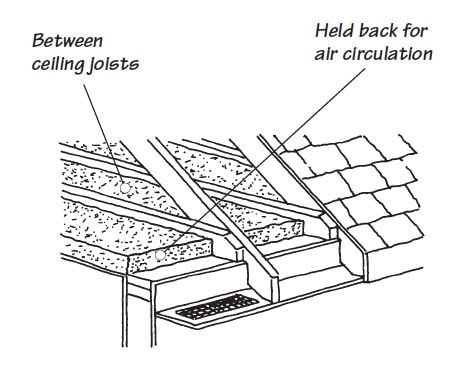
Properly installed fiberglass insulation can keep your dwelling well insulated and reduce your energy consumption for years to come.
Joe Truini is a home improvement expert who writes about a multifariousness of topics related to carpentry and plumbing. Joe is also the writer of numerous DIY books, including the best-selling Building a Shed. To learn more about choosing the right insulation and to see a wide diverseness of options, please visit The Abode Depot website.
This commodity is editorial content that has been contributed to HomeTips at our asking and is published for the do good of our readers. We take non been compensated for its placement.
Source: https://www.hometips.com/articles/how-to-install-fiberglass-insulation-like-a-pro.html
0 Response to "what to use to cover ceiling with fiberglass insulation"
Post a Comment