What Does St. Augustine Mean by the "City of God?" in Your Answer Reference Readings 8.6a and 8.6.
Quondam-earthers merits Augustine as support for figurative interpretations of Genesis 1. But what did Augustine actually say? In the video serial The Great Argue (watch | buy), AiG's Ken Ham, and Jason Lisle, argue astronomer Hugh Ross (of Reasons to Believe) and Bible scholar Walter Kaiser (of Gordon–Conwell Theological Seminary). Both of the latter are Christians who believe that the creation is billions of years erstwhile. The debate series was hosted by one-time-world proponent John Ankerberg on his television show in early 2006.
On AiG'due south DVD release of the contend, AiG historian of geology Terry Mortenson offered all-encompassing commentary from a young-globe creationist perspective. The following commodity is rooted in Dr. Mortenson's commentary on Ross'south and Kaiser's entreatment to Augustine in defending old-earth ideas.
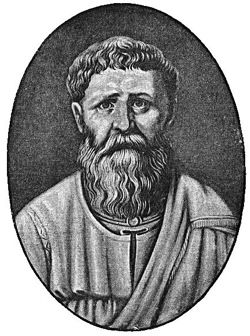
Augustine of Hippo (354–430)
Augustine of Hippo—famous church begetter, early theologian and . . . quondam-earth creationist?
Drs. Ross and Kaiser are merely two of the many old-globe proponents in the church building today who endeavour to use the Christian theologian Augustine (Advertizing 354–430) as a back up for their belief in millions of years. But the idea that Augustine believed that is a myth. At first glance, this apply of Augustine may seem to vest solely to the obscure domain of ancient church history or niche cosmos circles. However, the myth extends across that. For instance, Jim Manzi, writing in National Review Online in 2008 (and quoting a previous article he authored in National Review), passed the myth along:
Dealing with development places us dorsum in the visitor of Augustine and Aquinas, who were both forced to figure out how to reconcile powerful proto-scientific ideas with Christianity. They described God as acting through laws or processes. In almost the year 400, Augustine described a view of Creation in which "seeds of potentiality" were established past God, which and then unfolded through time in an incomprehensibly complicated set up of processes. . . .
Neither Augustine nor Aquinas was some kind of a pre-Darwinist. Augustine, for case, thought species were immutable and were non the product of mutual descent. What is hit virtually both of them, however, is their insistence on understanding and incorporating the all-time available non-theological thinking into our religious views.
Relying on this deep intellectual heritage, well-nigh major denominations in the Western world have accepted evolution as fully consequent with theism. Thoughtful conservatives would be wise to concord.
What Did Augustine Believe?
There are several problems with this view. To begin with, during the years AD 389-417, Augustine wrote iii commentaries on Genesis and discussed the early capacity of Genesis in The Urban center of God. His thinking changed in some ways in the process, and his writings are disruptive, even somewhat contradictory, at points. Over the years he fluctuated between allegorical interpretations and literal views.1 But in that location is plenty of evidence that Augustine wasn't an quondam-earther. Rather, he believed that God created everything in an instant and that He described it for us equally beingness completed in half-dozen normal days for the sake of our agreement. He wrote,
Perhaps we ought not to recall of these creatures at the moment they were produced as subject to the processes of nature which we at present observe in them, but rather every bit under the wonderful and unutterable power of the Wisdom of God, which reaches from end to finish mightily and governs all graciously. For this power of Divine Wisdom does non achieve past stages or get in by steps. Information technology was just every bit easy, and then, for God to create everything as information technology is for Wisdom to exercise this mighty power. For through Wisdom all things were made, and the motion we now see in creatures, measured by the lapse of time, as each one fulfills its proper office, comes to creatures from those causal reasons implanted in them, which God scattered every bit seeds at the moment of creation when He spoke and they were made, He allowable and they were created. Cosmos, therefore, did not take place slowly in society that a slow development might be implanted in those things that are wearisome past nature; nor were the ages established at plodding pace at which they now pass. Time brings virtually the evolution of these creatures according to the laws of their numbers, simply in that location was no passage of fourth dimension when they received these laws at creation.ii
Ane of several Peachy Debate segments in which Augustine is mentioned.
Furthermore, Augustine believed the genealogies given in Genesis to be literal chronologies and that the pre-Alluvion patriarchs lived to be around 900 years.3 He also stated, "Unbelievers are too deceived by faux documents which accredit to history many thousand years, although we can calculate from Sacred Scripture that non half-dozen,000 years take passed since the creation of human."4
Since Augustine believed that the original creation happened in an instant of fourth dimension, in that location is no basis for thinking that he believed millions of years of time transpired before Adam.
Furthermore, Augustine believed that Genesis 6–8 describes a global Flood. Once again, this distinguishes him from one-time-earthers like Hugh Ross who believe the Flood was a local ending in the Mesopotamian Valley (mod-twenty-four hours Iraq). Augustine spent five pages answering skeptical objections about the Alluvion covering all the highest mountains, the Ark being big enough, Noah having the ability to build it, and the feeding of carnivorous animals on the Ark.five
Some claim that Augustine and other Christians of the past only believed in a recent creation and a global Flood because they didn't have gimmicky old-globe and evolutionary theories to consider. (Indeed, some throw out the origins beliefs of all pre-19th-century Christians on these grounds.) Yet, early-20th-century evolutionist Henry Fairfield Osborn, manager of the American Museum of Natural History, wrote the post-obit:
When I began the search for anticipations of the evolutionary theory . . . I was led back to the Greek natural philosophers and I was astonished to discover how many of the pronounced and basic features of the Darwinian theory were anticipated even as far dorsum equally the seventh century BC.6
Augustine therefore had alternative "scientific" theories about earth history in his cultural context, but he refused to merge Scripture with such ideas.
Even and so the chronologies of Greek and Egyptian history do not hold; and since the former does not exceed the truthful number [of the duration of the world] unsaid in our Sacred Scripture, it may be accepted. Consequently, if this letter of Alexander [the Great] now so well known, is and then far from authentic in its chronology, we tin can trust still less those other [pagan] documents, so total of mythology, which are cited in opposition to the established authorization of inspired writings. The fact of the prediction that the whole world would believe and the fact that it has believed should prove that Sacred Scripture has given a true account of the past. Certainly, much that was predicted has been perfectly fulfilled.seven
In fact, he very specifically rejected the old-earth theories of some of his contemporaries, describing them in ways reminiscent of the uniformitarian and catastrophist theories of the 19th century:
I shall non dwell, and then on the conjectures of men who "know not what they say" concerning the nature and origin of the human being race. In that location are, for case, those who hold the opinion that men—like the universe—have ever existed. . . . Suppose the following questions are put to these men: If the human race has always existed, how, then practise you vindicate the truth of your own history which records the names of inventors and what they invented, the starting time founders of liberal education and of other arts, the start inhabitants of this or that region and of this or that island? They will answer that at certain intervals of fourth dimension, most of the land was so devastated by floods and fire that the human race was greatly reduced in size and that from this small number the former population was again restored; and that, thus, at intervals, there was a new discovery and organization of all these things, or, rather a restoration of what had been damaged or destroyed past the great devastations; and that, in any instance, men could simply not exist unless they were produced from homo. Of course, all this is stance, non science.8
Thus, Augustine conspicuously had one-time-earth views to contend with in his twenty-four hours—from the Greeks and from other pagans—merely he did non have them and did not endeavour to fit those ideas into Genesis.
What Augustine Didn't Know
That all said, we would exist remiss if nosotros claimed Augustine was an orthodox immature-globe creationist. Augustine rejected the vii-day cosmos beliefs of Ambrose, who was instrumental in Augustine's conversion to Christianity.
We would be remiss if we claimed Augustine was an orthodox young-earth creationist.
Yet Augustine didn't know Hebrew and but attained a minor knowledge of Greek past the end of his life, subsequently he had written his three commentaries on Genesis (and his volume Urban center of God, in which he also commented on Genesis 1–11).9 Augustine based his piece of work on the Old Latin Version (Vetus Latina), a translation of the Septuagint junior in accuracy to Jerome's later Latin Vulgate.
At first, this may seem to be a modest divergence that couldn't perchance mislead a reader. However, whereas in modernistic translations of the Hebrew word beyom in Genesis two:four it reads "in the day that"10 (or when 11) God created the heavens and the globe, the Old Latin translation renders it, "When day was made," God made heaven and earth. This mistaken translation makes it more understandable why Augustine believed God made everything in a single day or a unmarried instant. 12
Additionally, Augustine regarded the Apocrypha—which gives further support to the thought of an instant creation—as inerrant Scripture.13 Still, the Apocrypha is clearly not God's inerrant Word—encounter A Look at the Canon and Why 66?
What Augustine Couldn't Know
Not just did Augustine not back up old-earth views but he besides rightly considered himself a limited human and regarded his thinking on Genesis to be fallible. In the last book he wrote (about 3 years before his death), called Retractions, he sought to review all his books and make corrections where he had erred. Concerning his final, well-nigh literal commentary on Genesis, Augustine wrote, "In this work, many questions have been asked rather than solved, and of those which have been solved, fewer have been answered conclusively. Moreover, others have been proposed in such a way as to crave further investigation."14
On Speaking Without Cognition
Unremarkably, fifty-fifty a non-Christian knows something about the earth, the heavens, and the other elements of this world, about the motion and orbit of the stars and even their size and relative positions, about the anticipated eclipses of the sun and moon, the cycles of the years and the seasons, almost the kinds of animals, shrubs, stones, and and so forth, and this knowledge he holds to as being certain from reason and experience. Now, it is a disgraceful and dangerous thing for an infidel to hear a Christian, presumably giving the meaning of Holy Scripture, talking nonsense on these topics; and we should take all means to preclude such an embarrassing situation, in which people show up vast ignorance in a Christian and laugh information technology to contemptuousness.
–Augustine, The Literal Meaning of Genesis
This is precisely the reason we need to be knowledgeable, not just of God's Give-and-take only of prevalent teachings that seemingly contradict information technology, and then that we are able to properly defend our faith as 1 Peter iii:15 commands. Come across Should We Teach Evolution?
In the same commentary Augustine also rejected the allegorical interpretations found in his two earlier commentaries on Genesis, though he remained uncertain about his interpretation of the length of Cosmos Calendar week days.
Whoever, and so, does not accept the pregnant that my express powers have been able to observe or theorize but seeks in the enumeration of the days of creation a different meaning, which might exist understood not in the prophetical or figurative sense, simply literally and more than aptly, in interpreting the works of creation, let him search and observe a solution with God's assist. I myself may possibly discover some other pregnant more in harmony with the words of Scripture.xv
Though insisting that he was interpreting "day" literally, in that last commentary he had tended to regard at to the lowest degree the get-go 3 days (before the creation of the heavenly bodies) to be figurative—though he never ventured to say how long these non-literal days lasted. 2 years afterwards completing his last commentary on Genesis, Augustine wrote in Urban center of God, "As for these 'days,' it is difficult, perhaps impossible to think—let alone to explain in words—what they mean."16 So his statement in the Retractions indicates that he was still no more sure about the days of creation at the terminate of his life than he was in his earlier writings. He is hardly one to cite as an authority in support of the day-historic period view, as Ross and Kaiser (with many others) have washed.
Thus, Augustine offers no real support for old-earth views. He admitted his uncertainty and fallibility; he was significantly less educated on the issue than others; and fifty-fifty when he strayed from the Bible'south clear teaching, he but did so to espouse the possibility of cosmos in an instant—non one-time-globe ideas of his fourth dimension, and certainly not the millions-of-years ideas of old-world creationists today.
We also should keep in mind that the young-earth view has been, by far, the majority view of the church since it has been in existence—for eighteen centuries, whether from a Roman Cosmic, Protestant, or Eastern Orthodox perspective.17 The idea of an former earth—and the various compromise interpretations developed to fit billions of years into Creation Week—did not arise out of the Bible; they are attempts by, on the whole, well-pregnant Christians to integrate with Scripture what they believe (mistakenly) are scientific facts. They are thereby unknowingly elevating the naturalism-fueled speculations of secular science over the clear educational activity of Scripture. xviii The outcome dilutes both Scripture'due south educational activity and God's character, and it flies in the face of good scientific discipline.
For more information:
- The God of an Old Globe
- Where Did the Idea of "Millions of Years" Come From?
- Did Jesus Say He Created in Six Literal Days?
- Why Shouldn't Christians Accept Millions of Years?
- Could God Actually Accept Created Everything in Six Days?
- 10 Dangers of Theistic Evolution
- Biblical Problems for Theistic Development and Progressive Cosmos
- Theistic Evolution
Source: https://answersingenesis.org/days-of-creation/augustine-on-the-days-of-creation/
0 Response to "What Does St. Augustine Mean by the "City of God?" in Your Answer Reference Readings 8.6a and 8.6."
Post a Comment